Congenital Adrenal Hyperplasia and Pregnancy

Updated: Sep 28
Preparing the hormonal landscape for conception birth and beyond
Why the right hormone at the wrong time can delay pregnancy and how careful treatment can reopen the path

Carefully timed adrenal replacement can quiet excess precursors and reopen the sequence from ovulation to implantation and pregnancy.
The short answer Women with congenital adrenal hyperplasia can and do have successful pregnancies. The work begins before conception: identify the CAH phenotype, optimise glucocorticoid and mineralocorticoid treatment, bring follicular-phase progesterone below the proposed fertility target, clarify the partner’s genetic status and agree a pregnancy and delivery plan with a specialist team. During pregnancy, the laboratory numbers become noisy, so clinical judgement matters more than chasing every rising hormone.
The hormone that changes character halfway through the story
Imagine a woman with salt-wasting congenital adrenal hyperplasia who has spent years keeping her condition stable. She now wishes to become pregnant. Her cycles may even look reasonably regular, testosterone may not be dramatically raised and an ultrasound may show perfectly capable ovaries. Yet conception does not happen.
The missing clue may be progesterone. After ovulation, progesterone is indispensable: it prepares the endometrium for implantation and supports early pregnancy. Before ovulation, however, progesterone is supposed to remain very low. If adrenal progesterone is already elevated during the follicular phase, it behaves rather like a progestogen-only contraceptive. A vital hormone has simply arrived before its cue.
That paradox gives this entire subject its shape. Managing CAH around pregnancy is not only about replacing cortisol or reducing androgens. It is about restoring sequence. Endocrinology is rather particular about timing; it appears hormones can be correct in principle and still turn up at entirely the wrong meeting.
Three phenotypes and three rather different starting points
This article concentrates mainly on 21-hydroxylase deficiency, the commonest cause of CAH, and particularly on the classic salt-wasting form. The same enzyme block can produce a spectrum rather than three perfectly sealed boxes.
Phenotype | What the enzyme block means | Implication |
Salt wasting | Very little 21-hydroxylase activity causes clinically important cortisol and aldosterone deficiency, usually apparent in infancy. Lifelong glucocorticoid and mineralocorticoid replacement are required. | Hormonal control can be difficult; adrenal progesterone and androgens, anatomy and previous surgery may all affect fertility. Pregnancy requires adrenal-insufficiency planning. |
Simple virilising | A small amount of residual enzyme activity preserves enough mineralocorticoid function to prevent neonatal salt wasting, while cortisol synthesis remains impaired and androgen excess persists. | Glucocorticoid optimisation is central. Mineralocorticoid treatment may still become relevant when preparing for pregnancy if renin and progesterone suggest benefit. |
Non-classic | The enzyme retains substantially more activity. Most patients do not have clinically significant cortisol deficiency and the presentation may resemble PCOS, with irregular periods, acne or hirsutism. | Many need no lifelong steroid replacement. A low glucocorticoid dose may be considered for androgen excess, subfertility or recurrent miscarriage, but treatment is individualised. |
The distinction matters because pregnancy planning for a woman with salt-wasting CAH is fundamentally different from treating a woman with non-classic CAH who has normal cortisol reserve. One needs continuous replacement and emergency planning; the other may need temporary suppression of adrenal androgen production without being turned into a lifelong adrenal-insufficiency patient.
The blocked junction inside the adrenal gland
The adrenal gland normally uses 21-hydroxylase to move progesterone and 17-hydroxyprogesterone towards aldosterone and cortisol. When that junction is blocked, cortisol falls and the pituitary responds by releasing more ACTH. ACTH is the adrenal gland’s accelerator. It cannot repair the missing enzyme, so it pushes harder against the same blocked route.
Precursors accumulate behind the obstruction. Some are diverted towards androstenedione and testosterone; progesterone and 17-hydroxyprogesterone also rise. Glucocorticoid treatment supplies the missing cortisol signal and quietens ACTH. Fludrocortisone replaces aldosterone activity and quietens the renin–angiotensin drive. The medicines therefore do more than replace missing hormones: they reduce the pressure feeding the biochemical traffic jam.
Why fertility can be more difficult even when the ovaries are capable
Reduced fertility in classic CAH is rarely caused by one factor. Previous genital reconstructive surgery, vaginal or urogenital anatomy and personal choices around relationships can all matter. These subjects deserve sensitive, unhurried discussion rather than assumptions.
The hormonal barrier is often the most treatable. Adrenal progesterone, 17-hydroxyprogesterone and androgens can disturb the frequency and amplitude of gonadotrophin-releasing hormone pulses from the brain. The usual ovarian rhythm becomes less reliable, the mid-cycle LH surge may not occur and ovulation can become infrequent or disappear.
There are local effects too. Progesterone changes cervical mucus so sperm penetrate less easily. Excess 17-hydroxyprogesterone can bind the progesterone receptor or be converted towards progesterone, creating a progestogen-like signal. The endometrium may then mature out of step with the follicle and embryo. Ovulation, cervical access and implantation can therefore all receive the same unhelpful message: not now.
Progesterone and 17-OHP as unexpected contraceptive signals
A progestogen-only contraceptive works partly by thickening cervical mucus and, in some women, suppressing ovulation through the hypothalamic–pituitary–ovarian axis. Persistent adrenal progesterone and excessive 17-hydroxyprogesterone (17-OHP) can imitate parts of this physiology, although they are not prescribed contraceptives and their effects are less predictable.
This explains why ordinary CAH targets change when pregnancy is desired. Outside fertility treatment, clinicians usually accept mildly or moderately raised 17-hydroxyprogesterone if androstenedione and testosterone are controlled. Completely normalising every precursor often requires too much glucocorticoid, trading adrenal androgen excess for iatrogenic Cushing syndrome.
During preconception care, the balance shifts. Follicular development requires a genuinely low-progesterone window. A follicular-phase progesterone below 2 nmol/L, equivalent to about 0.6 ng/mL, has been proposed to support ovulation and fertilisation. It is a physiologically persuasive expert target, not a guarantee of conception and not yet validated by prospective trials.
Androstenedione and testosterone are related but not interchangeable
Androstenedione, often abbreviated to A4, is an androgen precursor produced prominently by the adrenal gland in CAH. Testosterone is more biologically potent and can be produced directly or formed from androstenedione in other tissues. Measuring both answers two different questions: how active is the adrenal androgen pathway, and how much potent androgen signal is reaching the circulation?
The androstenedione-to-testosterone ratio is especially useful in men with CAH because it helps distinguish adrenal from testicular androgen production. In women, the practical message is simpler: A4 is often the more adrenal-sensitive barometer, while testosterone reflects a more potent downstream exposure. They should be read together, from consistently timed samples, rather than made to compete for the title of “the real number”.
The preconception dashboard
Blood tests only become meaningful when the cycle day, clock time and relationship to the glucocorticoid dose are recorded. A sample taken before the morning dose tells a different story from one taken two hours afterwards. Repeating tests under comparable conditions is often more useful than collecting a larger number of incomparable ones.
Measure | Preconception Target | Reason |
Follicular progesterone | Below 2 nmol/L or 0.6 ng/mL | Supports follicular maturation, ovulation, sperm passage and correctly timed endometrial development. |
17 hydroxyprogesterone | Within the laboratory reference range for this fertility setting | Reduces progestogen-like interference and indicates tighter control than is usually required outside conception. |
Androstenedione and testosterone | Both within their reference ranges | Reduces androgen-related disruption of GnRH pulses and ovulation. |
Renin | Within the appropriate pre-pregnancy reference range | Helps judge mineralocorticoid adequacy and whether renin-driven adrenal stimulation remains active. |
These are navigational markers, not four buttons that produce pregnancy when illuminated green. Thyroid function, prolactin, ovarian reserve where indicated, semen analysis, tubal patency, age and general preconception health still belong in the assessment. Folate, medicines, vaccinations, emergency steroid supplies and sick-day knowledge should be reviewed before contraception is stopped.
The six step treatment staircase
The attached specialist framework is best understood as a staircase rather than a recipe. Each step asks whether control can be improved with the least additional glucocorticoid exposure. A woman should not climb it herself by changing doses; the entire point is to find the minimum effective treatment while watching for the harms of overtreatment.
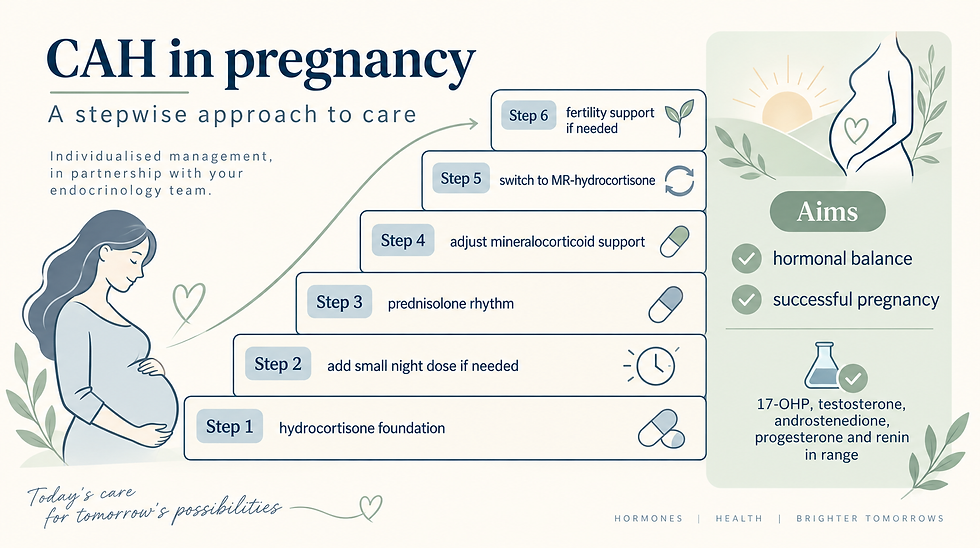
STEP | To Do | Logic |
1 | Optimise standard hydrocortisone | Confirm adherence, sample timing and dose distribution. Hydrocortisone is physiological and preferred around conception, but its short action may leave the early-morning ACTH rise uncovered. |
2 | Consider a small night-time prednisolone dose | Published expert strategies have used approximately 1 to 2.5 mg at night to extend overnight suppression. This is a specialist decision, not a universal starting dose. |
3 | Consider longer-acting prednisolone across the day | An eight-hourly regimen can provide steadier 24-hour control when hydrocortisone cannot suppress early-morning progesterone and 17-hydroxyprogesterone. The cost is greater risk of glucocorticoid excess. |
4 | Optimise or add fludrocortisone | In salt-wasting CAH the dose may need refinement; in selected simple-virilising CAH it may be introduced. Lowering renin drive may also reduce progesterone entering the blocked aldosterone pathway. This mechanism is plausible but not fully proven. |
5 | Consider modified-release hydrocortisone | Bedtime-weighted release can cover the pre-dawn ACTH rise more physiologically. Efmody is licensed for CAH, and a recent case achieved spontaneous pregnancy after switching, but prospective fertility evidence remains limited. |
6 | Use fertility treatment when appropriate | Ovulation induction, gonadotrophins, IVF or ICSI may be needed when spontaneous conception does not occur or another fertility factor exists. Hormonal and endometrial control remain relevant even when an embryo is created in the laboratory. |
Why timing may matter as much as the total dose
ACTH begins to rise in the early hours, often from around 3 am. A conventional evening dose may have faded by then. The morning tablet eventually restores control, but progesterone and 17-hydroxyprogesterone may already have enjoyed several unsupervised hours.
That is why an early-morning pre-dose 17-hydroxyprogesterone can reveal poor overnight coverage even when a later daytime result looks respectable. Modified-release hydrocortisone aims to release medicine before waking, while longer-acting prednisolone spans more of the night. Neither strategy is automatically superior; formulation, dose, timing, side effects and the woman’s individual pharmacokinetics all matter.
Dexamethasone is usually avoided for maternal CAH treatment when conception or pregnancy is possible because it crosses the placenta efficiently. Hydrocortisone and prednisolone are largely inactivated by placental 11β-hydroxysteroid dehydrogenase type 2, greatly limiting active fetal exposure. They are therefore the preferred glucocorticoids in this setting.
Why fludrocortisone may influence more than salt and blood pressure
Fludrocortisone replaces mineralocorticoid activity. In salt-wasting CAH it supports sodium balance, circulating volume and blood pressure while suppressing renin. The intriguing fertility connection comes from the blocked aldosterone pathway: progesterone is one of the substrates that would normally travel through it. If mineralocorticoid replacement is inadequate, the renin–angiotensin system may continue stimulating this part of the adrenal cortex, potentially adding to progesterone excess.
Optimising fludrocortisone can therefore lower renin and may also lower progesterone and 17-hydroxyprogesterone. The idea is biologically elegant and supported by specialist experience, but it remains a hypothesis rather than a universally proven fertility intervention. Blood pressure, sodium, potassium, swelling and symptoms of postural hypotension keep the treatment grounded in the patient rather than the diagram.
When the usual staircase is not enough
If progesterone remains high despite well-timed treatment, the team should revisit adherence, absorption, drug interactions, sampling time and whether the measurements truly cover the vulnerable overnight period. Simply increasing glucocorticoids indefinitely can produce weight gain, hypertension, diabetes risk, mood change, osteoporosis and Cushingoid features while still failing to create a sustained low-progesterone window.
Assisted reproduction should not be presented as failure. It is the next tool when ovulation remains unreliable, tubal or male factors coexist, age makes time important, or genetic testing of embryos is desired. Rare reports describe bilateral adrenalectomy restoring cycles and conception in exceptionally severe hyperandrogenism, but this is not routine treatment. It creates absolute lifelong adrenal dependence, carries surgical risk and can be followed by adrenal-rest tissue. It belongs only in highly selected multidisciplinary care.
Genetics before pregnancy because the arithmetic depends on who carries what
CAH due to 21-hydroxylase deficiency is autosomal recessive. A child is affected when a disease-causing CYP21A2 variant is inherited from each parent. The phrase “a 25% risk” is correct only for one particular pairing: two unaffected carriers.
Woman has classic CAH and partner is not a carrier | 0% affected; 100% carriers | The mother must pass one altered copy, while the partner supplies a working copy. |
Woman has classic CAH and partner is a carrier | 50% affected; 50% carriers | Half may inherit the partner’s altered copy as well as one from the mother. |
Both parents are unaffected carriers | 25% affected; 50% carriers; 25% unaffected non-carriers | This is the familiar one-in-four inheritance pattern. |
Woman has classic CAH and partner also has CAH | 100% affected | Each parent passes an altered copy. The likely phenotype depends on the variants inherited. |
Non-classic CAH needs genotype-specific counselling because many patients carry one variant associated with classic CAH and one milder variant. Partner testing, ideally before pregnancy, converts a vague population estimate into a couple-specific risk. In the UK, clinical genetics can discuss partner testing, non-invasive fetal sexing, targeted non-invasive prenatal diagnosis in eligible families, chorionic-villus sampling, amniocentesis and preimplantation genetic testing for monogenic disease.
Prenatal dexamethasone and the treatment that must not be confused with replacement
Prenatal dexamethasone is entirely different from treating the mother’s own CAH. Its experimental aim is to cross the placenta, suppress the adrenal gland of an affected female fetus and reduce virilisation of the external genitalia. To influence genital development it must begin very early, before definitive fetal sex and genotype are usually known.
That creates the ethical problem. When two unaffected parents are carriers, only one pregnancy in eight is expected to involve an affected female fetus, so seven may be exposed without possible benefit. If the mother has CAH and the father is a carrier, one pregnancy in four is expected to be an affected female, leaving three in four without that potential benefit. Long-term safety questions remain, despite evidence that early treatment can reduce virilisation.
For these reasons, the Endocrine Society and recent expert reviews regard prenatal dexamethasone as investigational and recommend it only within formally approved research protocols. It should not appear quietly in a routine pregnancy plan simply because dexamethasone is effective at crossing the placenta; that is precisely why caution is required.
Once pregnancy begins the laboratory rules change
Pregnancy manufactures hormones on an industrial scale. Progesterone may rise five- to twenty-fold, 17-hydroxyprogesterone rises, androstenedione increases early and then plateaus, cortisol-binding globulin rises and renin can increase eight- to twelve-fold. The preconception target sheet cannot simply be carried into the third trimester and marked in red pen.
This is why a pregnant woman with classic CAH should be reviewed at least once each trimester in a tertiary endocrine and obstetric service, with more frequent contact when symptoms, vomiting, blood pressure, diabetes risk or dose changes require it. Validated pregnancy-specific biochemical targets are lacking, so the clinician treats the woman, not a laboratory printout that pregnancy has cheerfully rearranged.
What we are looking for | Limitation | |
Symptoms and examination | Energy, nausea, vomiting, postural dizziness, pigmentation or virilisation, Cushingoid features, swelling and weight trajectory | Fatigue, nausea and weight change can be caused by pregnancy itself, so patterns and severity matter. |
Blood pressure and electrolytes | Mineralocorticoid under-replacement, excessive replacement, dehydration or hypertension | Normal pregnancy changes volume and vascular tone; single readings need context. |
Glucose assessment | Gestational diabetes and effects of glucocorticoid exposure | Reported risk varies between cohorts, but routine pregnancy screening remains appropriate. |
Free testosterone | A usable estimate of androgen control until approximately 28 weeks | Total testosterone and SHBG rise; later pregnancy interpretation becomes more difficult and depends on assay quality. |
17 hydroxyprogesterone A4 and renin | Trends may support the clinical picture | All rise physiologically. Renin is particularly unreliable for judging fludrocortisone during pregnancy. |
Glucocorticoid and mineralocorticoid treatment during pregnancy
Hydrocortisone or prednisolone is continued. The preparation that achieved stable preconception control is not casually dismantled after a positive test, but every medicine is reviewed promptly with the specialist team. Dexamethasone is avoided for routine maternal replacement because it escapes placental inactivation.
Some guidance extrapolated from primary adrenal insufficiency suggests increasing glucocorticoid by roughly 20% to 40% in the third trimester. The newest CAH review is more cautious: many women can remain on their preconception dose, and automatic escalation risks overtreatment. A near-physiological regimen may need an increase as pregnancy advances; an already suppressive regimen may not. The decision is clinical and individual.
Pre-pregnancy fludrocortisone is generally continued. Progesterone has anti-mineralocorticoid effects, so some women may need adjustment, but pregnancy itself raises renin profoundly. Dose decisions therefore rely on blood pressure, postural symptoms, sodium, potassium, oedema and overall clinical state rather than forcing renin into a non-pregnant range.
Vomiting is common in pregnancy but dangerous when steroid tablets do not stay down
Morning sickness is inconvenient for most people; for a woman dependent on glucocorticoids it can become an adrenal emergency. Repeated vomiting, inability to retain oral steroid, severe weakness, faintness, confusion, low blood pressure or collapse requires the emergency hydrocortisone plan and urgent medical assessment.
Before pregnancy, the woman and those close to her should know sick-day rules, how and when to use the emergency injection, and where the injection kit and steroid emergency card are kept. An antiemetic plan can be useful. The emergency instructions should travel with the maternity notes rather than relying on an exhausted patient to deliver an endocrine lecture from a trolley.
Planning the birth before labour begins
Vaginal birth can be possible, but previous genital reconstruction, vaginal anatomy, scar tissue, pelvic-floor function and the woman’s preferences need early obstetric assessment. Cohort studies report substantially higher caesarean rates in classic CAH, particularly the salt-wasting phenotype.
Whichever route is planned, labour and delivery are major physiological stress events. A written steroid plan should be visible to obstetrics, anaesthetics, endocrinology and the woman herself. Common specialist protocols give intravenous hydrocortisone at established active labour or before surgical delivery, often 100 mg initially, followed by 200 mg over 24 hours as an infusion or 50 mg every six hours. The exact plan is individualised to the duration and complications of labour.
Fluids, electrolytes, blood pressure and glucose are monitored. After an uncomplicated delivery, stress dosing is stepped down towards the pre-pregnancy regimen once the woman is clinically stable; it is never stopped abruptly. Caesarean and vaginal delivery require the same respect from the adrenal gland. It does not award fewer stress points for enthusiasm.
After birth and breastfeeding
Pregnancy hormones fall quickly after delivery, although some binding proteins and cortisol changes take longer to settle. The endocrine team reviews glucocorticoid and fludrocortisone needs, wound or infection stress, blood pressure, electrolytes and the return towards the preconception regimen. Sleep deprivation does not itself demand routine stress dosing, but fever, infection, significant blood loss, surgery or vomiting may do so.
Only small amounts of hydrocortisone and prednisolone enter breast milk, and breastfeeding is recommended when otherwise appropriate. The mother should continue her replacement exactly as advised. New parenthood is not the ideal moment for adrenal medication to become improvisational theatre.
A practical timeline
Stage | Priorities |
Before trying | Confirm phenotype and genotype; test the partner; assess anatomy and fertility factors; optimise hydrocortisone or prednisolone timing and fludrocortisone; document follicular progesterone; review emergency kit, folate and medicines. |
Positive pregnancy test | Contact endocrine and obstetric teams early; continue essential replacement; avoid routine dexamethasone; confirm genetics and fetal-testing choices without delay. |
Each trimester | Review clinically at least once; check blood pressure, electrolytes, glucose risk, weight and signs of steroid excess or deficiency; interpret hormone tests with pregnancy-aware caution. |
Third trimester | Decide whether glucocorticoid dose needs an individual increase; review fludrocortisone clinically; assess delivery anatomy and agree written stress-dose and anaesthetic plans. |
Labour or caesarean | Give intravenous stress-dose hydrocortisone according to the written plan; monitor fluids, blood pressure, electrolytes and glucose. |
Postpartum | Step down from stress dosing when stable; review maintenance treatment; support breastfeeding; reinforce sick-day rules and arrange endocrine follow-up. |
What the evidence can and cannot promise
The encouraging message is that the ovaries themselves are often capable and many women with CAH who wish to conceive eventually do so. Modern treatment, reconstructive care, reproductive medicine and genetic testing have altered what is possible. Recent international data describe favourable pregnancy outcomes, although time to conception can be prolonged.
The honest limitation is that much of the detailed preconception staircase comes from physiology, retrospective cohorts, case series and expert practice. No prospective trial has proved the ideal glucocorticoid preparation, exact progesterone threshold or universal dose schedule. Modified-release hydrocortisone is promising because it addresses the pre-dawn ACTH rise.
The elegance of management therefore lies in disciplined individualisation: suppress enough adrenal progesterone and androgen to restore reproductive timing, but not so much that glucocorticoid excess becomes the new disease. Pregnancy is not achieved by winning an argument with 17-hydroxyprogesterone. It is achieved by aligning biology, safety, genetics, anatomy and the couple’s priorities.
Questions to take to the specialist team
Which CAH phenotype and CYP21A2 variants do I have, and does my partner need carrier testing?
Were my progesterone, 17-hydroxyprogesterone, androstenedione and testosterone measured at the right cycle time and relative to my medication?
Is my follicular progesterone below the proposed 2 nmol/L fertility target?
Could adjusting fludrocortisone or overnight glucocorticoid coverage improve control without excessive steroid exposure?
Should my anatomy or previous genital surgery be reviewed before conception or delivery?
What is my written vomiting, adrenal-crisis and labour stress-dose plan?
Which prenatal or preimplantation genetic tests are available to us in the UK?
FAQ
Can women with salt wasting CAH become pregnant? Yes. Fertility may be reduced or conception delayed, but many women conceive after hormonal, anatomical and general fertility factors are addressed.
Why must progesterone be low before ovulation? Persistently raised follicular progesterone can suppress GnRH and ovulation, thicken cervical mucus and shift endometrial development out of time.
Are hydrocortisone and prednisolone safe in pregnancy? They are preferred because the placenta largely inactivates them, limiting fetal exposure. The lowest effective specialist dose is used.
Does every woman with CAH need a caesarean section? No. The decision depends on obstetric factors, vaginal anatomy, previous reconstruction and patient preference, although caesarean rates are higher in classic CAH.
What is the risk that my baby will have CAH? It depends on both parental genotypes. If a woman has classic CAH and her partner is not a carrier, all children are carriers but not affected; if he is a carrier, each pregnancy has a 50% affected risk.
Important CAH in pregnancy requires individual care from endocrinology, maternal medicine or high-risk obstetrics, clinical genetics and fertility specialists when needed. Never alter glucocorticoid or fludrocortisone treatment without clinical advice. Repeated vomiting or inability to retain steroid replacement can cause adrenal crisis and requires the emergency plan and urgent medical care.
Evidence and further reading
Evidence note The tiered preconception strategy and progesterone target reflect current specialist literature and physiological reasoning. The 2026 review explicitly notes that validated pregnancy-specific biochemical targets and prospective trials comparing regimens remain unavailable.

Comments