Hydrocortisone Emergency Injections

Updated: Sep 28
This article explains the practical emergency hydrocortisone injection options relevant to UK patients with adrenal insufficiency. It covers when the injection is needed, how the common preparations differ, and where patients can find demonstration videos for the specific kit they have been supplied.
How To Give An Emergency Steroid Injection In Adrenal Insufficiency
There are some medical instructions that are easy to understand in a clinic room and rather less charming at 2 am, when someone is vomiting, dizzy, frightened, and the injection kit has suddenly become the main character.
This page is about that moment.
People with adrenal insufficiency are usually taught to increase steroid tablets during illness. But if tablets cannot be kept down, or if adrenal crisis is suspected, the body needs hydrocortisone by injection. The injection is not a sign that things have gone wrong. It is the safety plan doing exactly what it was designed to do.
In the UK, most emergency kits use hydrocortisone sodium succinate 100 mg powder for solution. This needs mixing before injection. A simpler dual-chamber version, Act-O-Vial, contains hydrocortisone powder and sterile water in one vial, but it is not currently UK-licensed and is obtained through the unlicensed medicines route when a clinician feels it is appropriate.
Why the injection matters
Cortisol helps maintain blood pressure, blood sugar, salt-water balance and the body's response to severe illness. In adrenal insufficiency, the body cannot reliably produce the extra cortisol needed during major physical stress.
If someone is vomiting, severely unwell, collapsing, confused, very weak, or unable to absorb tablets, oral steroid may not reach the bloodstream quickly enough. The injection bypasses the stomach. It is the medical equivalent of using the emergency entrance rather than politely waiting at reception.
Once the emergency injection is given, urgent medical help is still needed. The injection buys time and protects against adrenal crisis, but the person may also need IV fluids, monitoring, further hydrocortisone and treatment of the trigger.
Just to repeat: The injection only buys time, until you can safely reach the hospital.
When to give the emergency hydrocortisone injection
The person cannot keep steroid tablets down because of vomiting.
There is repeated vomiting or severe diarrhoea.
The person is drowsy, confused, faint, collapsing or severely weak.
There are signs of adrenal crisis.
The person is too unwell to safely manage with oral tablets.
There has been a serious injury or major physical stress.
Emergency services or the endocrine team advise injection.
After giving the injection, call 999 or seek emergency medical care.
The main UK preparations
Preparation | Status | Practical Aspect |
Hydrocortisone sodium succinate 100 mg powder for solution | Routine UK emergency kit option | Powder and diluent must be mixed before drawing up and injecting. |
Act-O-Vial hydrocortisone sodium succinate 100 mg | Unlicensed in the UK, but may be imported or prescribed where clinically justified | Dual-chamber vial; fewer preparation steps. |
Hydrocortisone sodium phosphate liquid, previously Efcortesol | Discontinued in the UK in 2026 | Some patients may still have in-date vials; not the routine new supply. |
Option 1: Hydrocortisone powder plus separate diluent

The standard UK emergency hydrocortisone kit usually requires powder to be mixed with diluent before injection.
This is the standard UK preparation many patients will now receive. It usually involves a vial of hydrocortisone powder and a separate diluent ampoule or vial.
Get the kit out and stay as calm as possible.
Check the medicine name, dose and expiry date if time allows.
Open the diluent.
Draw up the diluent into the syringe.
Inject the diluent into the hydrocortisone powder vial.
Gently swirl until dissolved. Do not shake violently.
Draw the mixed solution back into the syringe.
Change needle if your kit instructions require it.
Inject into a large muscle, commonly the outer thigh.
Then Call 999 or seek urgent medical help.
This is a lot of small steps at exactly the moment when the body is not feeling cooperative. That is why practice matters. The first time someone handles the kit should not ideally be during an adrenal crisis.
Useful video links for powder hydrocortisone
Option 2: Act-O-Vial dual-chamber hydrocortisone
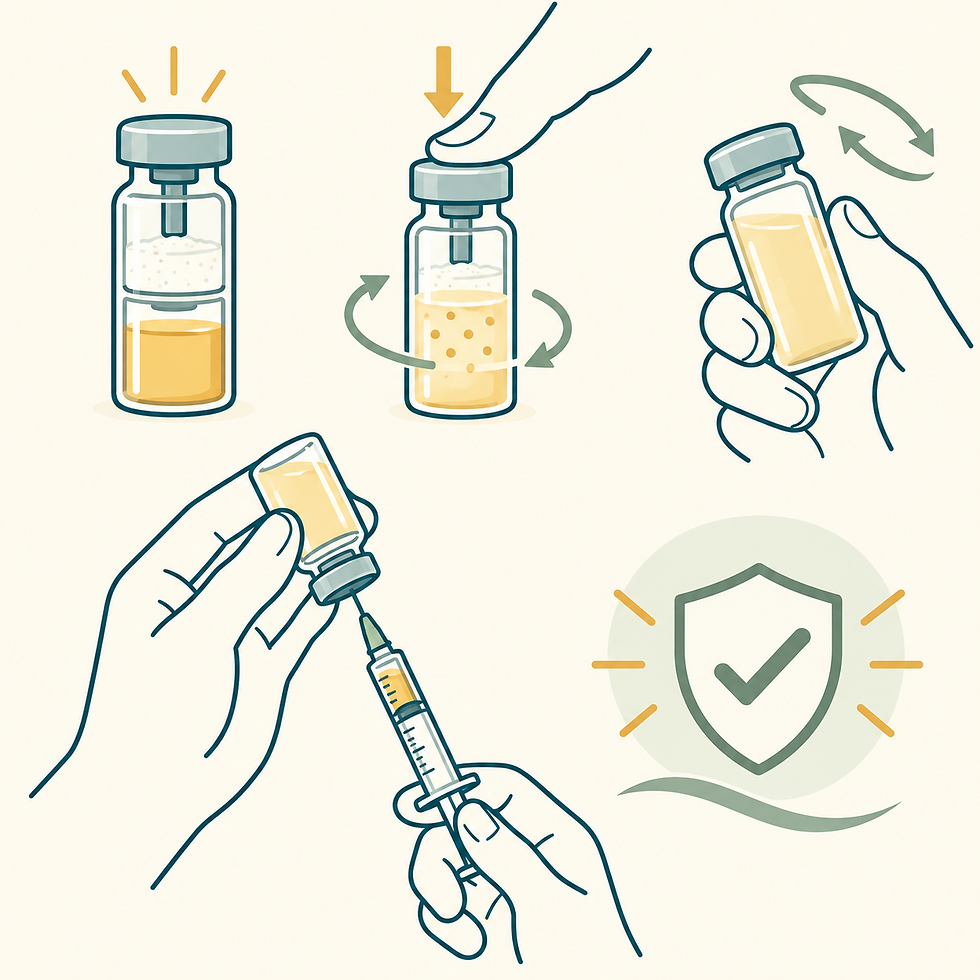
Dual-chamber preparations reduce the number of steps needed before emergency injection.
Act-O-Vial contains hydrocortisone sodium succinate and sterile water in one dual-chamber vial. Pressing the activator releases the liquid into the powder, so there is no separate ampoule to open and draw up first.
1. Press the activator to release the diluent into the powder chamber.
2. Gently mix until the powder dissolves.
3. Draw up the solution into the syringe.
4. Inject into a large muscle, commonly the outer thigh.
Then call 999 or seek urgent medical help.
The advantage is fewer preparation steps. This may be particularly relevant for people who live alone, have hand weakness, tremor, arthritis, visual impairment, previous adrenal crises, or low confidence with the multi-step powder-and-diluent kit.
Useful video link for Act-O-Vial
Option 3: Ready-mixed liquid hydrocortisone sodium phosphate
Some patients may still have in-date hydrocortisone sodium phosphate liquid vials, previously known as Efcortesol. This was easier in one sense because the liquid did not need to be mixed from powder before drawing up.
However, ADSHG states that hydrocortisone sodium phosphate was discontinued in 2026, so patients requesting a new UK prescription should expect hydrocortisone sodium succinate powder for solution rather than the older liquid preparation.
Check the vial and expiry date if time allows.
Draw up the liquid hydrocortisone into the syringe.
Inject into a large muscle, commonly the outer thigh.
Call 999 or seek urgent medical help.
Useful legacy video links for liquid hydrocortisone
Where to inject
For most emergency kits, the injection is given intramuscularly into a large muscle. The outer thigh is often the most practical site because it is easy to access quickly, including through clothing if necessary in a true emergency.
Patients should follow the training given by their endocrine team and the instructions supplied with their own kit. The exact needle and syringe set-up can vary, especially between adult and paediatric kits.
Who can give the injection
The person with adrenal insufficiency can self-inject if able. If not, a family member, friend, colleague or carer can give the injection if trained. A person who recognises adrenal crisis may administer the individual's prescribed emergency hydrocortisone injection for the purpose of saving life.
This is why practical rehearsal matters. The kit should not be a mysterious box that everyone respects from a distance. It should be opened, understood and practised with expired or demonstration materials where appropriate.
What should be in the kit
Hydrocortisone injection preparation.
Appropriate syringes and needles.
Written step-by-step instructions.
Steroid emergency card.
Medical alert information.
Expiry date reminder.
Spare vial if possible.
Sharps-safe plan.
Emergency contact details.
Copy of adrenal crisis guidance.
The most important message
The best emergency injection is not the one that looks neatest in the box. It is the one the patient, or someone close to them, can actually use when unwell.
For some people, the standard powder kit is perfectly manageable with training. For others, the number of steps may be a real barrier. Those patients should discuss Act-O-Vial with their endocrine team, especially if dexterity, vision, living alone, previous crisis experience or anxiety about preparation makes the standard kit hard to use.
Emergency hydrocortisone is not there to make patients anxious. It is there to give them back a measure of control. The small box in the cupboard is not a symbol of fragility; it is a quiet little insurance policy with a needle in it.
Further reading
ADSHG emergency injection guidance: https://www.addisonsdisease.org.uk/the-emergency-injection-for-the-treatment-of-adrenal-crisis
ADSHG Act-O-Vial in the UK: https://www.addisonsdisease.org.uk/act-o-vial-in-the-uk-unlicensed-medicine
NICE adrenal insufficiency guidance: https://www.nice.org.uk/guidance/ng243
Society for Endocrinology adrenal crisis guidance: https://www.endocrinology.org/clinical-practice/clinical-guidance/adrenal-crisis/


Comments